About Us
Over a twenty year period 10 issues have been published of the Jewish Women’s Literary Annual. Over 1500 individual works of poetry and prose have been published in its pages, along with some illustrations. Each issue of the Annual has been printed in 800 copies that have gone to subscribers as well as libraries, universities, synagogues, and other Jewish institutions for readers to enjoy. At present, 500 individuals and libraries subscribe to the Annual.
 Sometimes after an issue comes out, we get a lot of fan mail – BOTH from readers and from some of the authors. The writers are thrilled to be published in the same book with a Marge Piercy or an Alicia Ostriker. We, of course, are thrilled to get submissions from Marge and Alicia – except when we actually have to reject such a submission. That happened only recently, when we rejected a brand new poem by a well-known writer because it was a “holocaust” poem, and we made the decision five issues ago not to deal with this theme any more.
Much that comes in relates to news of the day, of course, and we don't accept these works either. The aim is purity and timelessness. That does not mean, however, that we demand some kind of neutral point of view: the point of view is always female – because the writers are women, whether young, old, gay or straight.
Our approach is dramatized at the book-launch party for a new issue, when each writer is invited to read for three minutes, from the new issue only. No introductory remarks when a woman is called to the microphone. It's more like an aliyah - just her name. We do not run the bios customary in other periodicals. Each work appears because of its own worth, regardless of who wrote it. There are no lopsided lists of what else our writers have done, which would result in some beginning writer seeing her lack of accomplishments advertised.
Submissions come in from Europe, Israel, Canada – some in French, Hebrew, German. We love to run them in their own language with English translation on the facing page. It makes a statement: a Jewish woman is a Jewish woman, wherever she lives.
Religiously, the writers and their readers fill the spectrum from secular to orthodox. They love to see one another at the launch party, which is always in New York: they come from as far as California or Montreal just to read for three minutes. But of course, it's not just to read- it's to hear and meet each other.
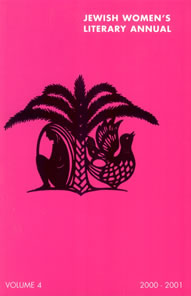
We read about a thousand submissions every year – sometimes twice that many. Writers find us in Poets Market, on the shelves of their synagogue libraries, and sometimes, perhaps, in the homes of their friends. The first “issue” was not a magazine at all but an anthology called Sarah’s Daughters Sing (KTAV, 1990). As people began to request a sequel, we decided to include prose, as well as art, photographs, drawings; and paper cuts (a traditional Jewish art form) by Tsirl Waletsky. We cannot run color inside, but the cover is always a different color with a different paper cut.
We used to have editing committees. Of the five women on the last of these committees, four have died and one has moved to Texas. To provide for the continuity of the work after Henny Wenkart is no longer able to edit the Annual, we have now added an associate editor, Dr. Sheri Lindner (see attached bio). Both the editor and associate editor read everything together, and so far have agreed on every decision - they both know what’s good and what is not.
The Annual always includes a section of Midrash - sometimes at the beginning, sometimes at the end, depending on the flow of a particular volume. In Volume 10 there are five very different voices about the binding of Isaac, for example.
In rejecting a piece of work, we sometimes make suggestions for its improvement. It is important, if we decide to do this, not to hold out false hope - some people just can not write well enough. On the other hand, we have been known to pick up the phone and call a writer whose work shows much promise, if she could only …
In this era of virtual publications and online community building, the Annual will evolve into a new format and form: By the end of 2015, authors will be easily located on a new website, and their works downloaded on demand. Past issues will be digitized and available to a larger audience worldwide. Beginning in the Fall, discussions between authors and their readers will take on the form of blog posts and webinars – and our readers will continue to relish the pleasure of picking up a printed copy of the book to enjoy a read through its pages, returning to favorite passages and short takes time and again.